Neil Santos Site

NOW AVAILABLE: The First-and-Only FDA-Approved PROTAC1
A PROTAC is a type of heterobifunctional protein degrader, a novel treatment class1,2
VEPPANU is indicated for the treatment of adults with estrogen receptor (ER)−positive, human epidermal growth factor 2 (HER2)−negative, estrogen receptor 1 (ESR1)−mutated advanced or metastatic breast cancer, as detected by an FDA-authorized test, with disease progression following at least one line of endocrine therapy.
2L=second line; ER+/HER2–=estrogen receptor–positive/human epidermal growth factor receptor 2–negative; ESR1m=estrogen receptor 1 mutation; FDA=US Food and Drug Administration; mBC=metastatic breast cancer; PROTAC=PROteolysis-TArgeting Chimera.

Frequently Asked Questions

What is VEPPANU?
VEPPANU is a PROTAC (PROteolysis TArgeting Chimera) ER degrader and the first in a novel class of drugs called heterobifunctional protein degraders.1,2
With 2 binding regions on one molecule, PROTACs harness the cell’s own protein disposal system—the ubiquitin proteasome system (or UPS)*—to degrade multiple estrogen receptor proteins before being metabolized. This leads to a reduction of ER protein levels in breast cancer cells.1-3†
VEPPANU is indicated for the treatment of adults with estrogen receptor (ER)–positive, human epidermal growth factor receptor 2 (HER2)–negative, estrogen receptor 1 (ESR1)–mutated advanced or metastatic breast cancer, as detected by an FDA-authorized test, with disease progression following at least one line of endocrine therapy.
*The UPS is part of normal, ongoing cellular maintenance that works to remove unneeded, misfolded, and/or damaged proteins.4
The clinical relevance of the mechanism of action is unknown.
VEPPANU was studied in VERITAC-2, a global, randomized, open-label, phase 3 trial of VEPPANU vs fulvestrant in 270 patients with ESR1m, ER+/HER2– mBC who had previously received endocrine therapy and a CDK4/6 inhibitor. The safety population included people with and without ESR1m (N=619).1,5
Patients received VEPPANU 200 mg orally once each day (n=136) or fulvestrant 500-mg IM injections on days 1 and 15 of cycle 1, then every 28 days from cycles 2+ (n=134). Patients were treated until disease progression or unacceptable toxicity.1,5
The primary endpoint was progression-free survival, as assessed by blinded independent central review according to RECIST, version 1.1. Secondary endpoints included overall survival, objective response (confirmed complete response or partial response) as assessed by blinded independent central review, and safety.1,5
VERITAC-2 included patients with a broad range of clinical characteristics including1:
  • 100% prior CDK4/6i + ET
  • 68% visceral disease
  • 20% pre- or perimenopausal status
  • 80% postmenopausal status
Discover all the data from the VERITAC-2 trial in The New England Journal of Medicine.

Secondary Endpoints

Primary Endpoint

PFS by RECIST v1.1 per BICR

OS, ORR, CBR, Safety

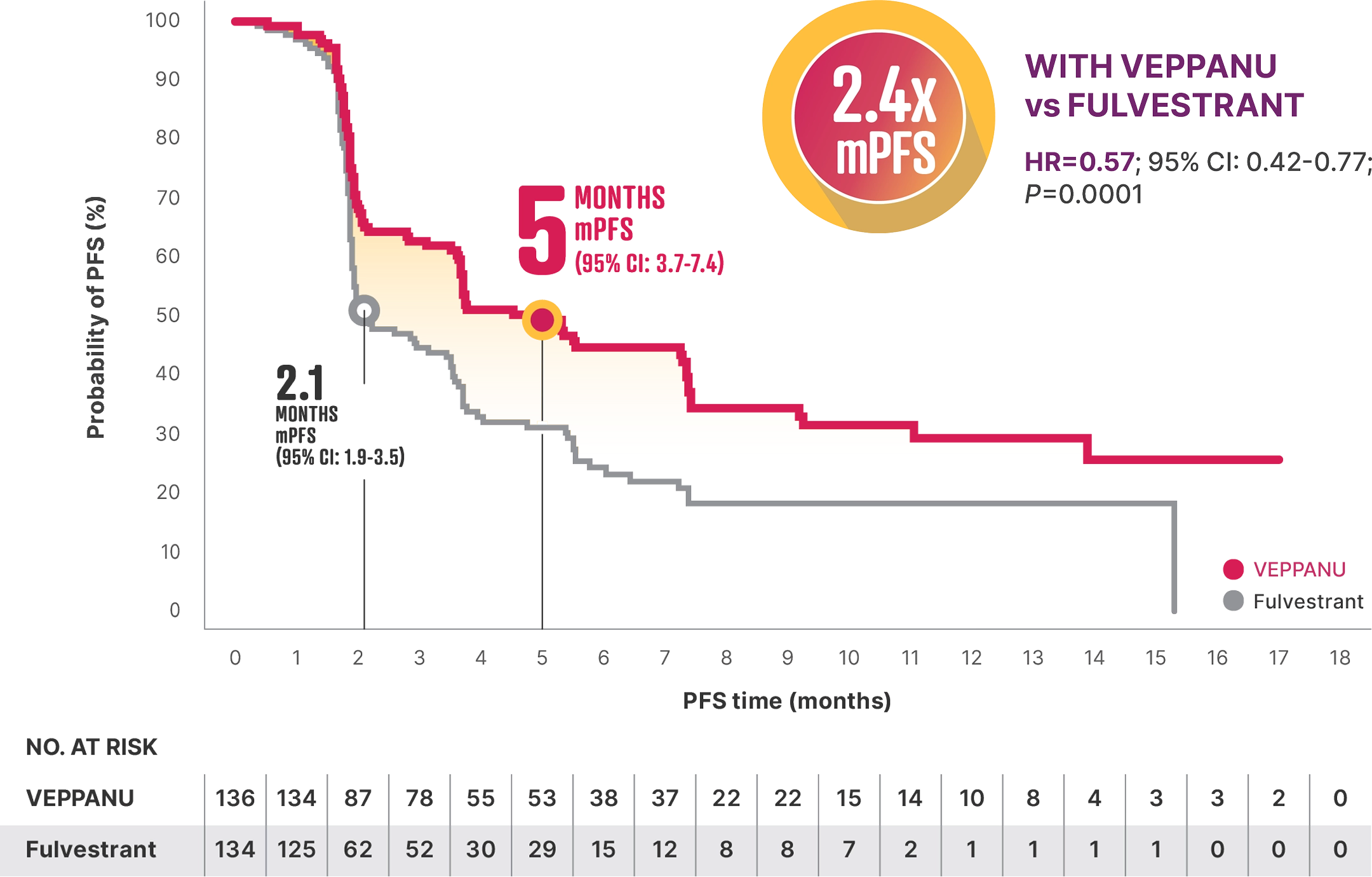
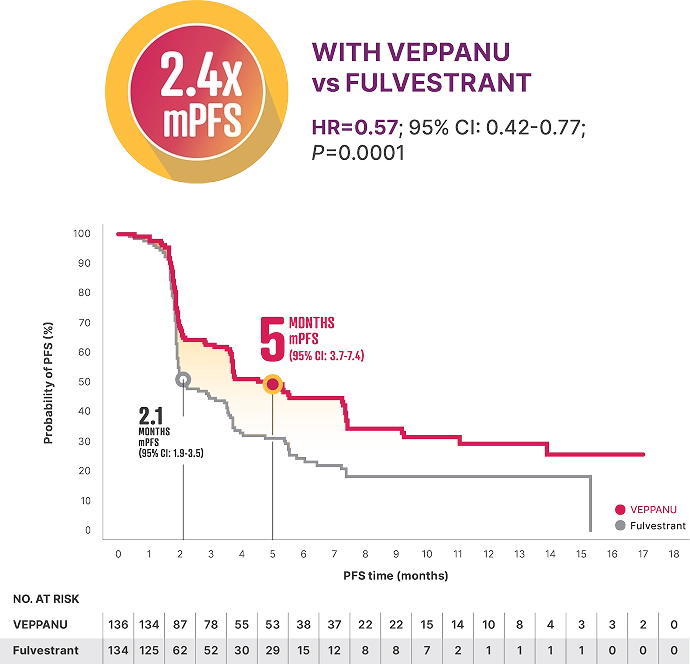
VERITAC-2 demonstrated superior efficacy with VEPPANU vs fulvestrant in patients with ESR1m, ER+/HER2− mBC1

PROGRESSION-FREE SURVIVAL (PRIMARY ENDPOINT)

In an open-label, randomized, phase 3 trial of patients with ESR1m, ER+/HER2– mBC (N=270)

SECONDARY ENDPOINTS1,5

VEPPANU
Fulvestrant
ORR‡§
19%
(95% CI: 12-27)
4%
(95% CI: 1.6-10)
CBR‡¶

42%

(95% CI: 33.7–51.1)
20%
(95% CI: 13.9-28.3)
Overall survival was immature at the time of PFS analysis.1
Results assessed by BICR. Efficacy results presented are from the ESR1m mBC population only (n=270); the trial included patients with and without identified ESR1 mutations (N=624). ESR1m status was determined by blood circulating tumor deoxyribonucleic acid (ctDNA). The other primary endpoint, PFS in the overall population, did not reach statistical significance. Median PFS follow-up: 7.4 months with VEPPANU and 6.0 months with fulvestrant.1,5
§ORR was defined as the proportion of confirmed complete response or partial response among patients with measurable disease at baseline. ORR was evaluated in 97 patients receiving VEPPANU and 100 patients receiving fulvestrant. Results assessed by BICR.6
CBR was defined as the proportion of patients who had confirmed complete response or partial response at any time, or stable disease, noncomplete response, or nonprogressive disease for ≥24 weeks (for patients enrolled for ≥24 weeks prior to data cutoff or those with confirmed CR or PR). CBR was evaluated in 121 patients receiving VEPPANU and 119 patients receiving fulvestrant. Results assessed by BICR.6
QTc Interval Prolongation1:
VEPPANU can cause QT (QTc) interval prolongation. Correct electrolyte abnormalities, including hypokalemia and hypomagnesemia, prior to and during treatment with VEPPANU. Perform an ECG prior to initiation of treatment with VEPPANU and do not initiate VEPPANU in patients with QTc >470 msec. Repeat ECG approximately 4 weeks after initiating treatment and as clinically indicated. Avoid concomitant use of VEPPANU with strong CYP3A inhibitors or drugs known to prolong the QTc interval.
Embryo-Fetal Toxicity1:
Based on findings from animal studies and its mechanism of action, VEPPANU can cause fetal harm when administered to a pregnant woman. Advise pregnant women and females of reproductive potential of the potential risk to a fetus. Advise females of reproductive potential to use effective contraception during treatment with VEPPANU and for 2 weeks after the last dose. Advise male patients with female partners of reproductive potential to use effective contraception during treatment with VEPPANU and for 2 weeks after the last dose.

Serious adverse reactions occurred in 9% of patients who received VEPPANU, including:

  • Any fracture (1.3%); fall, hypercalcemia, hepatic injury, pneumonia, musculoskeletal pain (0.6% each); and QTc prolonged (0.3%)1
  • The largest mean increase in QTc interval was 12 ms (upper CI: 15 ms) at the recommended dosage of 200 mg once daily1
Download the Full Prescribing Information for additional information on adverse reactions.
VERITAC-2 included patients with and without ESR1m (N=619) in the safety evaluation.1

MOST COMMON (≥10%) ADVERSE REACTIONS1#

VEPPANU (n=312) Fulvestrant (n=307)
Adverse Reaction All Grades (%) Grade 3 (%)|| All Grades (%) Grade 3 (%)||
Musculoskeletal and connective tissue disorders
Musculoskeletal pain** 30 2.6 23 1
General disorders
Fatigue** 29 1 16 1.3
Gastrointestinal disorders
Nausea 14 0 9 1
Constipation 10 0 3.3 0
Metabolism and nutrition disorders
Decreased appetite 11 0.3 5 0
Investigations
Electrocardiogram QT prolonged 10 1.6 1.3 0.3
#Adverse reactions were graded using NCI CTCAE version 5.0.
||No grade 4 events were reported in the VERITAC-2 study.
**Includes multiple related terms.

SELECT LABORATORY ABNORMALITIES (≥10%) THAT WORSENED FROM BASELINE1

VEPPANU (n=312)†† Fulvestrant (n=307)‡‡
Laboratory Abnormality All Grades (%) Grade 3/4 (%) All Grades (%) Grade 3/4 (%)
Hematology
White blood cells decreased 33 0.3 15 0.7
Hemoglobin decreased 24 2.3 20 3.6
Neutrophils decreased 23 2.3 13 0.7
Platelets decreased 10 1.3 11 1.3
Chemistry
Aspartate aminotransferase increased 31 1.6 23 1.7
Alanine aminotransferase increased 22 0.6 23 1.0
Alkaline phosphatase increased 21 0 23 0.3
Blood potassium decreased 14 2.6 6 0.3
Bilirubin increased 14 1.0 8 1.3
††The denominator used to calculate the rate varied between 308 and 310 based on the number of patients with a baseline value and at least one posttreatment value.
‡‡The denominator used to calculate the rate varied between 302 and 303 based on the number of patients with a baseline value and at least one posttreatment value.
Clinically relevant adverse reactions in <10% of patients who received VEPPANU included headache, hot flush, diarrhea, vomiting, bradycardia, and urinary tract infection.1

Download the Full Prescribing Information for additional information on adverse reactions.

of patients discontinued VEPPANU1,5
of patients needed dose interruptions1,5
of patients needed dose reductions1,5§§
Adverse Reactions That Led to Dose Modification1:
  • Permanent discontinuation occurred due to increased ALT and dyspnea (0.6% each)
  • No patients discontinued due to QT prolongation
  • Adverse reactions that required dose reductions were electrocardiogram QT prolonged, fatigue, and musculoskeletal pain (0.3% each)
Download the Full Prescribing Information for additional information on adverse reactions.1
§§Dose reductions of fulvestrant were not permitted.5

VEPPANU is a convenient once-daily oral tablet. It is available in 2 dose strengths1:

Recommended dose:
200-mg tablets
Dose for modifications:
100-mg tablets
Patients should take one 200-mg tablet once daily until disease progression or unacceptable toxicity1
  • 100-mg tablets are also available for dose modifications
VEPPANU should be taken with food, at approximately the same time each day1
VEPPANU should be swallowed whole, not chewed, crushed, dissolved, or split before swallowing. VEPPANU tablets that are broken, cracked, or look damaged should not be taken.1
  • If a patient misses a dose or vomits after taking a dose on a treatment day, the patient should take the next dose the following day at the regularly scheduled time
Prior to initiation of VEPPANU1:
  • Confirm presence of ESR1m
  • Correct electrolyte abnormalities
  • Perform an ECG; do not initiate if QTc >470 ms and avoid concomitant drugs known to prolong QTc interval¶¶
  • Repeat ECG approximately 4 weeks after initiating treatment and as clinically indicated
For more information about dosing and administration, download the VEPPANU Dosing and Administration Guide
¶¶For dosage modification and management for QTc prolongation or concomitant use of strong CYP3A inhibitors or inducers, see Full Prescribing Information for VEPPANU.1
No. There are no contraindications with VEPPANU.1
Before taking VEPPANU, tell your healthcare provider about all of your medical conditions, including if you1:
  • Have heart failure or heart rhythm problems, including QTc prolongation, and long QTc syndrome
  • Have low blood levels of potassium or magnesium
  • Are pregnant or plan to become pregnant. VEPPANU can harm your unborn baby
Females who are able to become pregnant:
  • Your healthcare provider may do a pregnancy test before you start treatment with VEPPANU
  • Use effective birth control (contraception) during treatment with VEPPANU and for 2 weeks after the last dose
  • Tell your healthcare provider right away if you become pregnant or think you may be pregnant during treatment with VEPPANU
Males with female partners who are able to become pregnant:
  • Use effective birth control (contraception) during treatment with VEPPANU and for 2 weeks after the last dose
  • Are breastfeeding or plan to breastfeed. It is not known if VEPPANU passes into your breast milk. Do not breastfeed during treatment with VEPPANU and for 2 weeks after the last dose
Tell your healthcare provider about all the medicines you take, including prescription and over-the-counter medicines, vitamins, and herbal supplements.
VEPPANU and other medicines may affect the way each other works and may cause serious side effects. Know the medicines you take. Keep a list of them to show your healthcare provider or pharmacist when you get a new medicine.
VEPPANU is available for ordering through an authorized network of:
  • Specialty pharmacies that can distribute directly to patients
  • Specialty distributors that can support integrated or in-office dispensing pharmacies
Download the Distribution Guide for details and contact information for authorized supplies.

RIGEL ONECARE Provides Support for Patients Taking VEPPANU

Contact RIGEL ONECARE at 1-833-744-3562 (833-RIGELOC) for patient support services including:

  • Benefits investigation, prior authorization, and appeals resources
  • Copay assistance##
  • Temporary and long-term free drug supply##
  • Adherence support and product education phone calls
Learn more at RigelONECARE.com
##All Rigel programs are subject to eligibility requirements. Restrictions apply.

Resources to Help You and Your Patients Get Started With VEPPANU

The New England Journal of Medicine: Vepdegestrant, a PROTAC ER degrader, in advanced breast cancer

Learn more about the global phase 3 VERITAC-2 trial.

Getting Started with VEPPANU: Patient Guide

Help patients learn about what to expect when starting treatment with VEPPANU.
VEPPANU Dosing and Administration Guide
Learn about dosing, administration, and management of potential adverse reactions.
VEPPANU Distribution Guide
Find information on VEPPANU distribution and pharmacy networks.
RIGEL ONECARE Program Overview
Learn more about the support and programs that are available.
RIGEL ONECARE Enrollment Form
Enroll your patients in RIGEL ONECARE to find support for every step of treatment, including how to access VEPPANU, copay assistance, and patient support services.

Note: Fields marked with an asterisk (*) are required.

Contact Rigel Medical Information for Product Questions or Medical Inquiries  

Call Rigel Medical Information Center at 1-800-983-1329 or email [email protected].

You may also report adverse events associated with taking our prescription drugs to the FDA.

You may also report adverse events associated with taking our prescription drugs to the FDA. Visit www.FDA.gov/medwatch or call 1-800-FDA-1088 (1-800-332-1088).
ALT=alanine aminotransferase; AST=aspartate aminotransferase; BICR=blinded independent central review; CBR=clinical benefit rate; CDK4/6=cyclin-dependent kinases 4 and 6; CDK4/6i=cyclin-dependent kinases 4 and 6 inhibitor; CR=complete response; CTCAE=National Cancer Institute Common Terminology Criteria for Adverse Events; ET=endocrine therapy; HR=hazard ratio; IM=intramuscular; mPFS=median progression-free survival; NCI=National Cancer Institute; ORR=objective response rate; OS=overall survival; PFS=progression-free survival; PR=partial response; QT=QT interval; QTc=corrected QT interval; RECIST=Response Evaluation Criteria in Solid Tumors.
References: 1. VEPPANU [package insert] South San Francisco, CA: Rigel Pharmaceuticals, Inc. 2. Hamilton EP, Jeselsohn RM, Vahdat LT, Hurvitz SA. PROteolysis TArgeting Chimera (PROTAC) estrogen receptor degraders for treatment of estrogen receptor–positive advanced breast cancer. Target Oncol. 2025;20(3):431-444. doi:10.1007/s11523-025-01137-5 3. Gough SM, Flanagan JJ, Teh J, et al. Oral estrogen receptor PROTAC vepdegestrant (ARV-471) is highly efficacious as monotherapy and in combination with CDK4/6 or PI3K/mTOR pathway inhibitors in preclinical ER+ breast cancer models. Clin Cancer Res. 2024;30(16):3549-3563. doi:10.1158/1078-0432.CCR-23-3465 4. Liu Z, Hu M, Yang Y, et al. An overview of PROTACs: a promising drug discovery paradigm. Mol Biomed. 2022;3(1):46. doi:10.1186/s43556-022-00112-0 5. Campone M, De Laurentiis M, Jhaveri K, et al. Vepdegestrant, a PROTAC estrogen receptor degrader, in advanced breast cancer. N Engl J Med. 2025;393(6):556-568. doi:10.1056/NEJMoa2505725 6. Campone M, De Laurentiis M, Jhaveri K, et al. Vepdegestrant, a PROTAC estrogen receptor degrader, in advanced breast cancer (supplement). N Engl J Med. 2025; doi:10.1056/NEJMoa2505725
Indication and Important Safety Information
WARNINGS AND PRECAUTIONS
QTc Interval Prolongation
VEPPANU can cause QT (QTc) interval prolongation. Correct electrolyte abnormalities, including hypokalemia and hypomagnesemia, prior to and during treatment with VEPPANU. Perform an ECG prior to initiation of treatment with VEPPANU and do not initiate VEPPANU in patients with QTc >470 msec. Repeat ECG approximately 4 weeks after initiating treatment and as clinically indicated. Avoid concomitant use of VEPPANU with strong CYP3A inhibitors or drugs known to prolong the QTc interval.

Indication

VEPPANU is indicated for the treatment of adults with estrogen receptor (ER)–positive, human epidermal growth factor receptor 2 (HER2)–negative, estrogen receptor–1 (ESR1)–mutated advanced or metastatic breast cancer, as detected by an FDA-authorized test, with disease progression following at least one line of endocrine therapy.

Important Safety Information

WARNINGS AND PRECAUTIONS

QTc Interval Prolongation

VEPPANU can cause QT (QTc) interval prolongation. Correct electrolyte abnormalities, including hypokalemia and hypomagnesemia, prior to and during treatment with VEPPANU. Perform an ECG prior to initiation of treatment with VEPPANU and do not initiate VEPPANU in patients with QTc >470 msec. Repeat ECG approximately 4 weeks after initiating treatment and as clinically indicated. Avoid concomitant use of VEPPANU with strong CYP3A inhibitors or drugs known to prolong the QTc interval.